Monday, September 3, 2012

DIY laser cutter from non-DIY parts

DIY laser cutter from non-DIY parts:

[Jerry] missed the laser cutters he had been using at the local TechShop. It closed down and after seeing some hardware in a surplus store he decided to build a laser cutter to call his own. You won’t be disappointed by his build log. It’s got a ton of hi-res images and plenty of explanation.
Often, cost is the key consideration in these types of builds. [Jerry] spent a little more than average, but look what he got back out of it. This started as a CNC machine aimed at loading silicon wafers for a company making electron microscopes. It’s barely been used, and the light-duty specs will work just fine with a laser cutter as the gantry won’t be moving much weight or fighting the rotational force of a mill motor. He tore out the stock controllers and built his own, adding a q-switched 355nm Frequency Tripled DPSS laser along the way. We’re not quite sure what that means… but in laymen’s terms it’s an ultraviolet laser source. See the finished unit cutting out some Kapton in the clip after the break.
http://www.youtube.com/watch?v=HA4cvwn1U_A

Filed under: cnc hacks, laser hacks

RC plane made specifically for UAVs

RC plane made specifically for UAVs:

We’ve seen our fair share of remote-controlled planes turned into UAVs and FPV platforms, but the Techpod is the first airplane we’ve seen specifically designed to be used as a camera-equipped robotic airplane.
The Techpod is the brainchild of [Wayne Garris]. He has been flying camera-equipped FPV airplanes for a while now, but recently realized the current offerings of remote control planes didn’t match his needs. [Wayne] decided to design his own plane specifically designed with a pan/tilt camera mount in the nose.
[Wayne]‘s prototype was designed with some very fancy aeronautical design software packages and milled out of foam. From the videos after the break, we can see the Techpod flies beautifully, but needs the Kickstarter community to bring his model to the masses.
The specs for the Techpod put it up there with other high-performances FPV and UAV models; with its 102 inch (2590 mm) wingspan and a pair of batteries wired in parallel, the Techpod can stay aloft transmitting video for up to one hour.
Video of the plane in action after the break.


Filed under: kickstarter, robots hacks, toy hacks

Lazy Labor day educational time. Watch Cornell’s microcontroller courses.

Lazy Labor day educational time. Watch Cornell’s microcontroller courses.:


C’mon, you know you’re not really going to do much today. You might as well spend that time learning some skills instead of watching funny cats. The Cornell ECE lectures on microcontrollers (ECE 4760 and ECE5760), taught by [Bruce Land], are available online for free.
Not only do you get to enjoy these two courses, but there are videos available showing off several different categories of student projects as well.


[via hackedgadgets]

Filed under: Hackaday links

Wednesday, August 29, 2012

Resistors and power ratings

Resistors and power ratings:

Kenneth discusses resistors and power ratings:
Resistors are possibly the most basic component of electronics; given an input voltage, they allow a current to flow, and given an input current to flow, they produce a voltage.  The relationship between the voltage and current is linear (a straight line), (mostly) frequency independent (unlike capacitors or inductors), and only dependent on its resistance (expressed in ohms).
Via TweetDeck.

What does the government think about that drone in your home?

What does the government think about that drone in your home?:
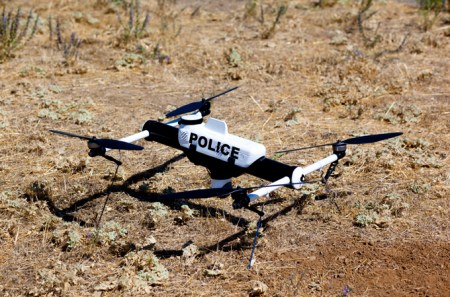
The world is buzzing about drones right now. Even we’re joining in the fun with some antics of our own. Right now, it is basically a legal free-for all since no one is enforcing regulation, but is that about to change? Should it?
Lets start off by establishing the definition of a “drone”. For this article, we’ll settle for any “unmanned aerial vehicle”, though we can all agree that that limiting this to airspace is fairly restrictive. This is the specific type that are making the news right now and quite possibly catching the eye of people who make the rules.

During my fun exploring the different ways to cause a little mischief by hacking a fairly limited Parrot AR Drone, I met some resistance on user forums from people concerned that I would usher in a new set of legislation restricting the use of drones by weaponizing them. While we all can agree that irresponsible use of dangerous things is bad, the idea that my little taserDrone would garner government attention was laughable.
However, I felt that a little research was necessary into how the FAA feels about drones, since it seems that everyone is putting them in the air.  I found some interesting things. Most notably, the modifications of adding further flight distance and better cameras seems to be the biggest concern for people, and is likely to be the cause of legislation due to privacy issues.
At present, the FAA already has regulation in place for drones and has for some time. To use one above 400 feet, you must be registered with the FAA and issued a certificate, of which they’ve only issued a few hundred. The law also states that you can not use the drone for commercial purposes. This has actually become an issue as one real estate company found out when they started hiring drones to photograph the properties they were listing.
With the swarm on the horizon, the FAA realizes they have to approach this. They’ve created an entire office dedicated to integrating drones into airspace an are actually attempting to loosen up the restrictions for drone use.  Keep in mind, however, that this doesn’t just mean [Joe] next door with his hacked AR Drone, but also the police. This is a big deal to many who already feel like they live in a current state surveillance.  This year the FAA actually had a presence and spoke at the Unmanned Vehicle Systems International trade show in Los Vegas, for the first time in its 39 year run.
So it seems that the prime concerns surrounding drones right now are air safety and privacy. We all know they can be weaponized. We’ve all seen the military drones. Apparently, a gun mounted on a drone is no more scary than a gun on a hip or on a car. What people are more concerned about are prying eyes.  So when I attempt to strap a bottle rocket to my drone, maybe people shouldn’t freak out. Maybe they should actually reconsider strapping that high definition camera to their drone and flying it over their neighborhood.
Then again, this is hackaday. All we ask is that you don’t hurt anyone and try to show a little respect to eachother while you do whatever you want to that thing you OWN.

Filed under: news


Monday, August 27, 2012

The Basics of Thermocouples

The Basics of Thermocouples:

Curious about thermocouples and how they work?  The Basics of Thermocouples  from Circuit Cellar does a good job of answering a lot of questions about how they function, and how to use them.

Hubble’s Hidden Treasures

Hubble’s Hidden Treasures:
Ann1211A
100358
Hubble’s Hidden Treasures.
Last March, the operators of the Hubble Space Telescope launched a competition, inviting amateur astronomers to dig into hundreds of thousands of images of outer space, helping discover hidden treasures and bring them to light. Yesterday, NASA and the European Space Agency announced the winners in both categories: image processing, where entrants composed their own images based on Hubble data, and image search, where entrants simply uncovered amazing images not previously released. Collected here are 16 of the winning images. Be sure to visit the Hubble site to see them all.

Sunday, August 26, 2012

“I am, and ever will be, a white socks, pocket protector, nerdy engineer”

“I am, and ever will be, a white socks, pocket protector, nerdy engineer”:
Neil
Neil Armstrong, First Man on Moon, Dies at 82 @ NYTimes.com.
Although he had been a Navy fighter pilot, a test pilot for NASA’s forerunner and an astronaut, Mr. Armstrong never allowed himself to be caught up in the celebrity and glamour of the space program.
“I am, and ever will be, a white socks, pocket protector, nerdy engineer,” he said in February 2000 in one a rare public appearance. “And I take a substantial amount of pride in the accomplishments of my profession.”
Full quote: ““I am, and ever will be, a white-socks, pocket-protector, nerdy engineer, born under the second law of thermodynamics, steeped in steam tables, in love with free-body diagrams, transformed by Laplace and propelled by compressible flow.”

The $100 tri-copter

The $100 tri-copter:

We’ve seen lots of budget tri-copters, but $100 seems like a heck of a deal to us! Watching this video, you can see this home made tri-copter is incredibly agile and seems to handle quite well. Whats amazing is that [hallstudio] claims that it cost roughly $100. That price is really good compared to even the cheapest multi copters out there.
Much of the manufacturing cost associated with this kind of thing has been removed as the body is just cheap wood from the local hardware store. He even did an admittedly sloppy rig for his tail rotor, not that it looks like it has hurt his performance.  One cool feature is the fact that you can fold the front arms backward, allowing for the tri-copter to be shoved into a bag for easy transportation.
You can find a complete parts list on his video, but it looks like maybe his cost doesn’t figure in the cost of the radio controller. There are no build instructions, but a quick google search leads us to the rcexplorer tricopter which seems to be the template he used. There are full build details there.

[via Hackedgadgets]

Filed under: toy hacks

Thursday, August 23, 2012

Procyon – 80 MHz ARM Cortex M3 with SDRAM, Ethernet, SD, USB

Procyon – 80 MHz ARM Cortex M3 with SDRAM, Ethernet, SD, USB:

Procyon is a general purpose development board with special features for Ethernet, USB, and audio applications. It is based on Luminary Micro/Texas Instruments LM3S9x9x series of parts. The initial MCU is LM3S9B90.
The board contains the following features:
  • 80 MHz, 100 Pin Cortex M3 Processor
  • 16 MB SDRAM accessed on a 50 MHz EPI bus
  • USB Host/Device/OTG port
  • microSD card slot (Attached to SSI1/SPI1)
  • 10/100 Ethernet
  • I2S header for DAC output interface
  • Up to 24 GPIOs available
  • 3 UART, 2 I2C, 1 CAN, 2 SPI/SSI (one shared with microSD card)
  • 10-bit ADCs
  • General purpose timers: four 32-bit or eight 16-bit
  • FTDI/Basic UART debug/program interface, on 16 pin GPIO/configuration header
  • Three 10 pin headers for daughter boards
  • 20 Pin JTAG Header
  • User LED and User switch
Procyon – 80 MHz ARM Cortex M3 with SDRAM, Ethernet, SD, USB - [Link]